Expert Allergy & Immunology Care Across London
Your private allergy clinics in Harley Street, Chiswick, Shepherds bush and New Malden, with secure telemedicine appointments across the UK
Welcome to the London Allergy and Immunology Centre. We provide consultant-led allergy testing and treatment in London for adults and children with hay fever, food allergy, pet allergy, eczema, urticaria, suspected anaphylaxis, allergic rhinitis, asthma-related allergy symptoms and complex immune-mediated presentations.
Our approach combines a careful clinical history with validated allergy investigations, including skin prick testing, specific IgE blood testing, and molecular allergy diagnostics where clinically appropriate. We focus on accurate diagnosis, practical management and personalised long-term care.
- ✓Consultant allergy care for adults, children and babies
- ✓In-person clinics in Central, West and South London
- ✓Remote assessments and postal testing support across the UK
- ✓Evidence-based treatment plans tailored to symptoms, risks and lifestyle
Why patients choose our allergy clinic
- ✓Specialist assessment of food, respiratory, skin and complex allergy
- ✓More than 600 allergen tests available when clinically indicated
- ✓Advanced component-resolved allergy testing including ALEX3
- ✓Clear explanation of results and next steps
- ✓Rapid access to follow-up and ongoing care planning
Allergy testing
Comprehensive assessment for food allergy, hay fever, pet allergy, house dust mite allergy, drug allergy, urticaria, eczema and allergic asthma.
Precision diagnostics
Molecular allergy testing can help distinguish genuine sensitisation from cross-reactivity in selected cases and support more individualised advice.
Personalised treatment
Management may include avoidance advice, medication optimisation, emergency planning, immunotherapy discussion and specialist follow-up.
Remote access
Patients across England, Scotland, Wales and Northern Ireland can access expert review through remote consultations and selected postal testing pathways.
Comprehensive Allergy Services from Leading London Specialists
As a leading private allergy clinic in London, we investigate symptoms carefully rather than relying on broad screening alone. A precise diagnosis matters because many reactions that appear to be allergy are not caused by IgE-mediated disease, while some patients require more detailed evaluation to identify clinically relevant triggers, cross-reactive proteins or risk markers.
Recent allergy literature continues to support a precision medicine approach, especially in allergic rhinitis, food allergy and severe allergic disease. In practical terms, this means choosing the right test for the right patient, interpreting results in the context of symptoms, and using those findings to guide targeted management rather than unnecessary restriction.
Advanced Diagnostics & Validated Allergy Testing
Accurate allergy diagnosis begins with a consultant review of your symptom history, timing, trigger pattern, severity and co-existing conditions. Depending on your presentation, we may recommend one or more of the following:
- ✓Skin prick testing for common inhalant and food allergens, with rapid in-clinic results
- ✓Specific IgE blood testing for food and airborne allergens
- ✓Molecular allergy diagnostics and ALEX3 to examine sensitisation to individual allergen components where this is likely to improve interpretation
- ✓Patch testing in selected skin presentations where contact allergy is suspected
- ✓Additional laboratory investigations where clinically appropriate
- ✓Remote testing pathways for selected patients unable to attend in person
Component-resolved testing can be especially useful in selected food allergy cases, such as distinguishing genuine peanut allergy from pollen-related cross-reactivity, clarifying nut or wheat sensitisation, and supporting interpretation where standard testing leaves uncertainty.
Why validated testing matters
We use medically validated investigations and clinically recognised pathways. This is important because not all commercially promoted “allergy tests” are reliable. In line with current professional guidance, tests such as IgG food panels, hair analysis, bioresonance and similar alternative methods are not accepted as valid diagnostic tests for food allergy.
Important: A positive allergy test does not always mean clinically significant allergy. Test results must be interpreted alongside your symptoms, medical history and, when needed, supervised specialist assessment.

Food allergy assessment
Evaluation of immediate food reactions, nut allergy, milk and egg allergy, wheat allergy, seafood allergy, oral allergy syndrome and suspected anaphylaxis, with tailored dietary and emergency advice.
Respiratory allergy care
Assessment and treatment planning for hay fever, allergic rhinitis, dust mite allergy, pet allergy, mould sensitisation and allergy-associated asthma symptoms.
Skin and urticaria expertise
Consultant review for eczema, recurrent hives, angioedema and inducible urticarias, with treatment plans based on current guideline-led, steroid-sparing care.
Evidence-Based Treatment Planning
Following diagnosis, our consultants create a management plan tailored to the individual rather than a one-size-fits-all protocol. Your plan may include trigger reduction, medication review, written emergency advice, travel planning, follow-up testing, and discussion of advanced treatments where appropriate.
Modern allergy care is evolving quickly. Recent literature highlights continuing progress in molecular diagnostics, biologic therapies and more precise treatment selection across allergic diseases. For chronic urticaria, current guidance continues to prioritise second-generation antihistamines, careful use of control scores, steroid-sparing treatment pathways and specialist escalation for refractory disease. In selected severe allergic conditions, biologic therapy may also be considered by specialist teams.
Personalised Treatment & Long-Term Care
- ✓Clear avoidance and exposure-reduction advice when truly necessary
- ✓Medication plans for rhinitis, urticaria, eczema and allergy-related respiratory symptoms
- ✓Emergency planning for patients at risk of significant reactions
- ✓Sublingual immunotherapy for selected inhalant allergies where suitable
- ✓Specialist review of persistent or complex allergic disease
- ✓Discussion of advanced therapies, including biologics, in selected cases
- ✓Continuity of care through our Global Allergy Network for travellers where available
Modern allergy care for 2026
Recent research continues to support more individualised management for selected patients with complex food allergy and severe allergic disease. Biologic-based strategies, including omalizumab pathways, are expanding options for some patients with multiple food allergies, although suitability depends on age, diagnosis, risk profile, licensing status and specialist assessment.
Where newer treatment options are relevant, we discuss benefits, limitations, monitoring requirements and whether they fit your overall clinical picture.
Why Choose Our London Allergy Clinic?
Consultant-led care
Patients are assessed by experienced allergy and immunology specialists with expertise in both adult and paediatric allergy.
Focused, evidence-based diagnosis
We prioritise validated investigations and careful clinical interpretation rather than over-testing or misleading alternative methods.
Convenient access
Choose from Harley Street, Chiswick, New Malden or secure video consultation, with straightforward online booking and rapid appointment access.
Book an Allergy Consultation Online
Booking your allergy or immunology consultation is simple.
- 1 Register Carebit electronic patient records account
- 2 Choose immunology/allergy clinic and for allergy testing clinic location and preferred appointment time (Make sure to avoid antihistamines for 2 days prior the face to face testing appointment)
- 3Make a £300 payment if your are a self funded patient and before your appointment time log into your video meeting or attend the testing clinic at your preferred appointment time
Registration is quick and only required once.
Appointment & payment information
Prepayment of the £300 consultation fee is required for self-paying patients by bank transfer or card.
Please also review our insurance information below (AXA and Vitality policy holders would require prepayment).
- ✓Urgent same-day appointments may be available
- ✓Please register online before calling for urgent availability
- ✓We operate a strict 24-hour cancellation policy
- ✓A £300 fee applies for missed appointments or late cancellations with less than 24 hours’ notice
- ✓To cancel or rebook, please log in to your patient account at least 24 hours in advance
Our London Clinic Locations
- ✓Harley Street Allergy Clinics:
9 Harley Street, London W1G 9QY (corrspondence) - 130 Harley Street, London W1G 7JU,
-
42 Foley St London W1W 7TS
- ✓West London Allergy Clinics: Shepherds Bush and Chiswick
Convenient for West London patients and families - 1 Blythe Rd, London W14 0HG
- 347-353 Chiswick High Rd., Chiswick, London W4 4HS
- ✓New Malden Clinic South London Allergy Clinic (monthly)
171 Clarence Avenue, New Malden, KT3 3TX - ✓Telemedicine appointments (daily) Immunology Urticaria and Angioedema and Allergy
Secure video consultations for patients across the UK and internationally
Need an urgent appointment?
If you need a prompt assessment for suspected allergy, urticaria, anaphylaxis risk, medication queries or symptom deterioration, please register online first and then call us on 020 3143 3449.
We aim to make specialist allergy care accessible, whether you need in-person testing in London or a remote consultation from elsewhere in the UK.
Meet Our Lead Consultant
Our clinic is led by Professor Michael Rudenko, Consultant in Allergy & Clinical Immunology, with extensive experience in adult and paediatric allergy. Our wider team supports patients with expertise spanning allergy, immunology, dermatology, ENT and paediatrics, helping us take a multidisciplinary approach when symptoms overlap.
We remain committed to evidence-based practice, continuing medical education and keeping up with developments in international allergy and immunology research.
Insurance & Billing
We are recognised by many major UK and international private health insurers, including:
- ✓AVIVA (600079116)
- ✓BUPA & Benenden
- ✓CIGNA (000HA24955)
- ✓Allianz Worldwide
- ✓WPA (920513101)
- ✓Freedom Health, Exeter Friendly, CS Healthcare and others
Please note: We can bill directly BUPA and Benenden, but to book an appointment we require a referral letter from GP or consultant. We do not bill directly to AXA PPP or Vitality. Patients with these insurers usually pay upfront and, where eligible, may seek reimbursement directly from their insurer.
Registered correspondence address:
London Allergy and Immunology Centre
9 Harley Street, London W1G 9QY
Refund Policy
- ✓Consultation fees are refundable if cancelled at least 48 hours in advance, subject to a £15 admin fee
- ✓Testing kit fees are refundable within 14 days if the kit is returned unused, subject to a £15 admin fee
- ✓Once a laboratory sample has been processed, the test fee is non-refundable
Frequently Asked Questions
Do I need an allergy blood test or a skin prick test?The best test depends on your symptoms, age, medications, skin condition and suspected trigger. In some cases, both may be helpful. The right investigation is chosen after consultant assessment.
Is molecular allergy testing suitable for everyone?No. Molecular or component-resolved testing is most useful in selected situations where it can improve interpretation, clarify cross-reactivity or support risk assessment.
Can I book from outside London?Yes. We offer telemedicine consultations and selected remote testing pathways for patients across the UK.
Allergy and Immunology Care in London and Online
The London Allergy and Immunology Centre provides private allergy and immunology care in London and online, with specialist consultants, advanced allergy testing and personalised treatment for adults and children across the UK and worldwide.
We offer consultant-led care in London together with remote consultations, UK-wide testing pathways and international continuity of care for travelling patients.
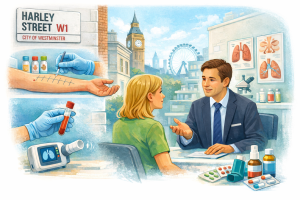

Our Workflow Process
A clear overview of our step-by-step approach to allergy management, ensuring you are informed and involved at every stage.
Why Choose Us?
Discover the unique advantages we offer to every patient seeking effective management for allergies and immunological disorders.

Our Services
Patient Testimonials
"The team at Allergy Centre London transformed my life by helping me understand my allergies and providing a clear treatment plan. Highly recommend!"

"After struggling with chronic urticaria for years, I finally found relief thanks to the expert care at this clinic. A true lifesaver!"

"Expert guidance and a tailored approach. The staff was so understanding and professional throughout my treatment. Thank you!"

Excellence in Allergy Care. Confidence in Life.
Allergy and Immunology Care Global Network: Our clinic offers service to international patients, telemedicine, remote allergy consultations and medical tourism to London.
We are a part of Global Allergy Network and have ACARE and UCARE accreditations, Allergy tests take place in our London clinics and combined with UK-wide remote access for international continuity.
Contact Us & Book Your Consultation
Take the first step towards better allergy control, clearer answers and a treatment plan built around your symptoms and goals.
London Allergy and Immunology Centre
Phone: 020 3143 3449
Fax: 020 3143 3409
Email: info@ukallergy.com
Main Clinic: 9 Harley Street, London W1G 9QY
Multilingual Headline Options for International Patients
English
Private Allergy and Immunology Care in London and Online, with Specialist Consultants, Advanced Allergy Testing and Personalised Treatment Available Across the UK and Worldwide
العربية
رعاية خاصة للحساسية والمناعة في لندن وعبر الإنترنت، مع استشاريين متخصصين، وفحوصات حساسية متقدمة، وخطط علاج شخصية متاحة في جميع أنحاء المملكة المتحدة وحول العالم
Français
Soins privés d’allergologie et d’immunologie à Londres et en ligne, avec des spécialistes, des tests allergologiques avancés et des traitements personnalisés disponibles au Royaume-Uni et dans le monde entier
Deutsch
Private Allergie- und Immunologieversorgung in London und online, mit spezialisierten Fachärzten, moderner Allergiediagnostik und individueller Behandlung im Vereinigten Königreich und weltweit
Español
Atención privada de alergia e inmunología en Londres y en línea, con especialistas, pruebas avanzadas de alergia y tratamientos personalizados disponibles en todo el Reino Unido y en todo el mundo
Italiano
Assistenza privata di allergologia e immunologia a Londra e online, con specialisti, test allergologici avanzati e trattamenti personalizzati disponibili nel Regno Unito e in tutto il mondo
中文(简体)
伦敦及线上私人过敏与免疫科医疗服务,由专科顾问医生提供先进过敏检测和个性化治疗,服务覆盖英国各地及全球患者
Русский
Частная аллергологическая и иммунологическая помощь в Лондоне и онлайн, со специалистами-консультантами, современным аллергологическим тестированием и персонализированным лечением по всей Великобритании и во всём мире
Türkçe
Londra’da ve çevrim içi özel alerji ve immünoloji hizmeti; uzman danışman hekimler, ileri alerji testleri ve Birleşik Krallık genelinde ve dünya çapında sunulan kişiselleştirilmiş tedavi seçenekleri